Building a Bitcoin treasury requires board approval, policy development, custody selection, accounting setup, and donor communication. This step-by-step guide covers every phase of the process for nonprofit boards.
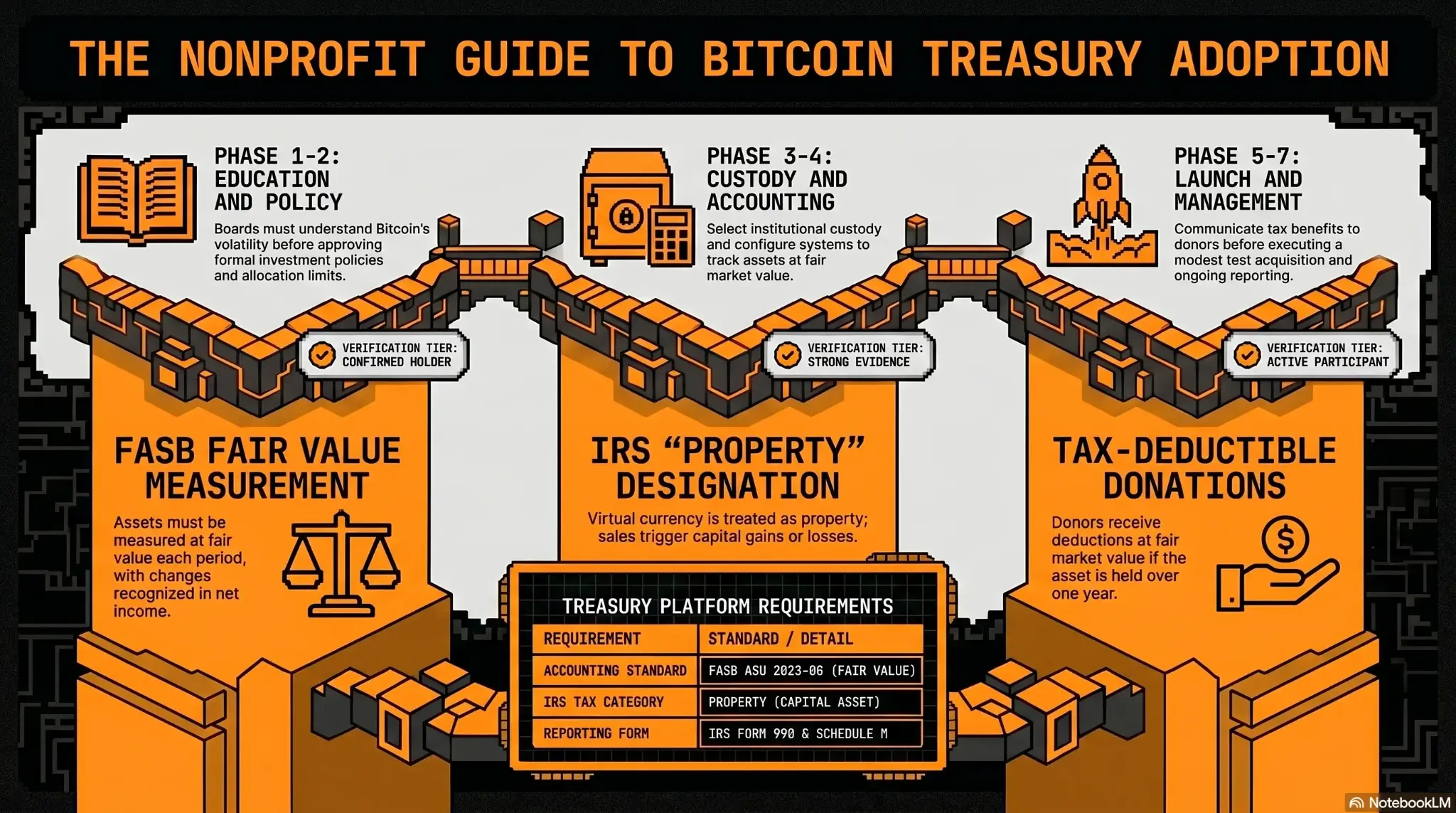
Building a Bitcoin treasury is a multi-phase process that requires board approval, policy development, operational setup, and ongoing management. This guide covers every phase of the process for nonprofit boards considering Bitcoin treasury adoption.
Phase 1: Board Education and Decision. The first step is ensuring that the board has sufficient understanding of Bitcoin to make an informed decision about treasury allocation. This typically requires a dedicated board education session covering Bitcoin's monetary properties, historical performance, volatility profile, and the operational requirements of holding Bitcoin. Organizations like HRF and OpenSats have developed board education materials that can be adapted for this purpose.
Phase 2: Policy Development. Before acquiring any Bitcoin, the board must approve a formal investment policy that addresses allocation limits, custody requirements, volatility risk management, liquidation procedures, reporting requirements, and donor disclosure. The policy should be developed with input from the organization's legal counsel and accountants, and should be reviewed by the board's finance committee before full board approval.
Phase 3: Custody Selection. Selecting a custody solution is the most consequential operational decision in the Bitcoin treasury setup process. Options range from self-custody using hardware wallets to institutional custodians that provide professional key management, insurance, and reporting. For most nonprofits, an institutional custodian is the appropriate choice for the majority of Bitcoin holdings, with self-custody reserved for a small operational float.
Phase 4: Accounting Setup. The organization's accounting system must be configured to track Bitcoin holdings at fair market value, record unrealized gains and losses, and generate the reports required for Form 990 filing and financial statement preparation. Most modern nonprofit accounting software supports cryptocurrency tracking, but configuration and staff training are required.
Phase 5: Donor Communication. Before accepting Bitcoin donations or announcing a Bitcoin treasury initiative, the organization should develop clear donor communication materials that explain the organization's Bitcoin policy, the tax advantages of Bitcoin donations, and the procedures for making Bitcoin contributions. This communication should be reviewed by legal counsel to ensure accuracy.
Phase 6: Initial Acquisition. The organization's first Bitcoin acquisition should be modest — consistent with the allocation limits established in the investment policy — and should be used to test the operational procedures developed in earlier phases. This test acquisition allows the organization to identify and resolve operational issues before managing larger Bitcoin holdings.
Phase 7: Ongoing Management. Bitcoin treasury management is an ongoing process that requires regular reporting to the board, periodic policy review, and active management of custody and accounting procedures. Organizations should designate a specific officer responsible for Bitcoin treasury management and ensure that this officer has the training and resources required to manage the organization's Bitcoin holdings effectively.
The organizations featured in this directory have all completed this process and have developed operational frameworks that can serve as reference models. HRF's dual USD/BTC treasury model, OpenSats' 100% Bitcoin treasury, and RFUS's Treasury for the Trees initiative each represent a different approach to Bitcoin treasury adoption, and each offers valuable lessons for organizations at different stages of the adoption process.
SLIDE DECK: BITCOIN TREASURY ROADMAP FOR NONPROFIT BOARDS
A board-ready visual guide covering governance, custody, accounting, risk controls, donor workflows, and ongoing oversight for nonprofits considering whether to hold Bitcoin as part of treasury reserves.
This 16-slide deck was built for nonprofit finance committees and boards of directors evaluating whether to hold Bitcoin as a treasury reserve asset. It walks through the complete decision framework: from fiduciary duty analysis and pre-decision professional review, through board approval mechanics and formal policy drafting, to custody model selection, internal controls, IRS donation workflows, and ongoing governance. The deck is structured for a single board session and is designed to surface the right questions before any capital commitment is made.
The accounting section covers FASB ASU 2023-08 fair-value measurement requirements, on-chain audit trail documentation, and IRS Form 8282/8283 workflows for non-cash charitable contributions. The custody section presents a decision framework comparing institutional custody, collaborative multisig, and internal self-custody, with a comparison matrix covering operational complexity, counterparty risk, and auditability. The risk register identifies four threat categories — volatility, custody failure, cyberattack, and reputational risk — with defined mitigations for each.
Organizations such as the Human Rights Foundation, OpenSats, and Brink are among the nonprofits that have publicly committed to holding Bitcoin as a long-term treasury reserve. Their governance structures and public disclosures informed the policy framework outlined in this deck. For additional context on how organizations verify and document Bitcoin holdings, see the Verification Methodology and Resources pages.
Building a Bitcoin Treasury: A Step-by-Step Guide for Nonprofit Boards
The title slide establishes the scope: governance, controls, and implementation for institutional reserves. The deck is framed as a board-level briefing, not a technical or investment document. The footer disclaimer makes clear that this material is educational and does not constitute legal, tax, accounting, investment, or custody advice.
Why This Matters
Frames the strategic context in three columns: the premise (nonprofits are shifting from immediate BTC liquidation to strategic holding), the requirement (this shift introduces custody, accounting, and regulatory variables that demand board-level governance), and the objective (a sequential, prudent framework for evaluation, approval, implementation, and oversight). This slide establishes why the board needs a formal process rather than an ad hoc decision.
Status Quo vs. Strategic Shift
A two-column comparison of the accept-and-convert model versus the accept-and-hold model. The status quo captures crypto-native donations with zero price volatility and zero active custody risk. The strategic shift introduces balance sheet volatility and requires active custody and strict policy oversight in exchange for long-term value preservation potential. The core question for the board: does the organization's mission and risk tolerance support this move?
Why Nonprofits Consider Holding Bitcoin
Four strategic rationales: donor alignment (meeting the expectations of Bitcoin-native donors who prefer to fund organizations that share their conviction), mission continuity (holding a borderless, censorship-resistant asset for operational funding in volatile geopolitical environments), inflation concerns (a fixed 21-million supply cap as a potential hedge against fiat debasement), and long-term treasury strategy (diversifying a small, predefined percentage of reserves for potential long-term value preservation while accepting short-term volatility).
Fiduciary Duty and Mission Alignment
A three-part fiduciary analysis: duty of care (the board must fully educate itself on Bitcoin's mechanical properties, volatility profile, and custody risks — ignorance is a breach of duty for novel assets), duty of loyalty (adoption must serve the organization's specific mission and charitable purpose, not the personal financial ideologies of individual board members), and liquidity versus volatility (evaluating whether the nonprofit has sufficient fiat runway — 12 to 24 months — to avoid forced selling during a market drawdown).
Pre-Decision Professional Review
Four mandatory professional review areas before board approval: legal and governance (state-specific nonprofit regulations and UPMIFA compliance), tax and IRS (Form 8282/8283 documentation workflows for non-cash charitable contributions), accounting and audit (confirming FASB ASU 2023-08 fair-value tracking capability in existing accounting software), and investment policy (reconciling a Bitcoin allocation with existing donor restrictions, endowments, and ESG mandates). No board vote should proceed without completing all four reviews.
Board Approval Process
A four-step sequential approval process: education phase (dedicated board sessions covering monetary properties, volatility profiles, and operational requirements), committee review (Finance and Audit committees draft the preliminary policy framework and consult outside professionals), written recommendation (formal presentation of the drafted policy, risk register, and implementation plan to the full board), and board resolution (formal vote explicitly approving the Treasury Policy and allocation limits, documented in official board minutes). Each step must be completed before advancing to the next.
Anatomy of a Bitcoin Treasury Policy
Nine required components of a formal Bitcoin Treasury Policy document: purpose and mission fit (strategic rationale), allocation limits (maximum percentage of total reserves allowed in BTC), custody model and signers (approved key management structure), approval authority (who is authorized to initiate and approve transfers), liquidation rules (defined conditions or thresholds for selling), donor restrictions (handling restricted versus unrestricted BTC donations), reporting cadence (monthly and quarterly board dashboard requirements), emergency procedures (protocols for suspected breaches or key loss), and annual review mandate (required yearly re-evaluation of the policy).
Custody Model Decision Framework
A decision flowchart and comparison matrix for selecting a custody model. Organizations without internal technical expertise should default to institutional custody. Organizations with technical expertise must then assess whether holdings are material to the balance sheet: material holdings warrant collaborative multisig with geographically distributed signers; non-material holdings may use internal self-custody for small operational floats. The matrix compares all three models across operational complexity, counterparty risk, auditability, and insurance availability.
Internal Controls and Signer Governance
Four governance requirements for a multisig treasury vault: separation of duties (the individual initiating a transaction cannot be the same individual approving it), signer roles (distributing private keys across distinct parties such as the Executive Director, Board Treasurer, and an independent institutional key-agent), succession planning (documented, legally sound procedures for replacing a signer if a board member leaves, becomes incapacitated, or loses a key), and access control and incident response (pre-approved organizational protocols for suspected security breaches or unauthorized access attempts).
Donation Acceptance and IRS Workflow
A six-step sequential workflow: donor initiates transfer, BTC arrives in the designated wallet, timestamped USD fair market value is recorded at the exact moment of ledger confirmation (IRS requirement per FAQ 12/27), donor receives automated tax receipt with Form 8283 support for donations over $5,000, the asset is logged in the general ledger under crypto asset tracking, and the transaction is aggregated into quarterly treasury oversight dashboards. Each step has defined documentation requirements to support both donor acknowledgment and IRS compliance.
Accounting and Audit Readiness
Four compliance areas under FASB ASU 2023-08 (Intangibles — Goodwill and Other — Crypto Assets, Subtopic 350-60): confirming accounting software can track fair value measurements and recognize gains and losses in net income, maintaining on-chain transaction hashes and wallet addresses as immutable audit trails, documenting proof of multisig approvals and signer access logs for external auditors, and establishing internal processes for filing Form 8282 if donated BTC is liquidated within three years of receipt (IRS FAQ 37).
Treasury Risk Register
Four risk categories with defined threat levels and mitigations: volatility (severe price drawdowns impacting the balance sheet — mitigated by strict allocation limits such as a maximum 5% of reserves and maintaining 12 to 24 months of fiat cash buffer), custody failure and key loss (total, unrecoverable loss of funds — mitigated by multisig architecture, geographic key distribution, and strict succession protocols), cyberattack and internal fraud (hacking or internal theft — mitigated by mandatory hardware wallets, strict separation of duties, and zero hot-wallet exposure for reserve funds), and reputational and regulatory risk (donor alienation or audit complexity — mitigated by a clear, mission-aligned communication strategy and proactive consultation with specialized CPA firms).
90-Day Implementation Roadmap
A three-phase implementation timeline: Phase 1 (Days 1 to 30) covers board education sessions and preliminary professional reviews with external legal, tax, and CPA counsel. Phase 2 (Days 31 to 60) covers drafting the formal Treasury Policy, selecting the custody model, and defining internal controls and signer roles. Phase 3 (Days 61 to 90) covers executing the formal board vote and resolution, configuring accounting software for fair-value tracking, executing a small pilot transaction, and establishing the reporting cadence. The 90-day structure is designed to prevent rushed implementation while maintaining board momentum.
Ongoing Treasury Management
Four ongoing management pillars in a continuous cycle: board reporting (monthly or quarterly dashboards showing USD fair value, current allocation percentage, and custody health status), rebalancing rules (mechanical, emotionless buying or selling based strictly on approved policy thresholds, not market sentiment), annual policy review (scheduled board review to adapt to new FASB and IRS regulations, market conditions, or organizational shifts), and stakeholder communication (transparently updating donors and supporters on treasury health, strategy, and overall mission impact). Ongoing management is not optional — it is a governance requirement once a Bitcoin treasury policy is adopted.
Final Board Governance Checklist
A ten-item pre-implementation checklist that the board must complete before any capital commitment:
- 1. Board education session fully completed.
- 2. Outside legal and tax counsel consulted.
- 3. Accounting software confirmed capable of FASB fair-value tracking.
- 4. Fiat operational runway verified (insulating against BTC volatility).
- 5. Custody model selected, vetted, and approved.
- 6. Internal controls and signer separation of duties documented.
- 7. Donation acceptance and IRS acknowledgment workflow established.
- 8. Formal Bitcoin Treasury Policy drafted and reviewed by Finance Committee.
- 9. Final Board Resolution formally voted and recorded in official minutes.
- 10. Small test transaction scheduled before full capital implementation.
This deck is for educational and governance discussion purposes only. It does not constitute legal, financial, tax, accounting, investment, or custody advice. Nonprofits should consult qualified legal, tax, accounting, audit, and custody professionals before implementing a Bitcoin treasury strategy.
Use this deck as the starting point for your finance committee discussion. Download the PDF, share it with your board, and work through the 90-day roadmap with qualified legal and accounting counsel. If your organization already holds Bitcoin as a treasury reserve, submit your org to the directory so others can learn from your governance model.
Jimmy Bearden
Jimmy Bearden is a systems-driven digital entrepreneur and founder of Zenogram Digital Marketing Agency LLC. He publishes original research on Bitcoin nonprofit treasury strategy, compliance, and adoption at the Bitcoin Nonprofit Directory.
View Author Page